Not Sure Where To Start?
One question. Seven possible paths. Find the right articles for your financial situation in seconds.


I find myself utterly captivated by the cinematic masterpiece Everything Everywhere All at Once. Right from the instant I caught the trailer, I sensed it was crafted just for someone like me. My instincts proved spot on. This film’s eccentric fusion of high-octane action, profound philosophical musings, mind-bending science fiction, everyday tax woes, and irreverent youthful comedy seems tailor-made to resonate with my particular mindset and thought processes.
For anyone not yet acquainted with the story, allow me to offer a concise overview of the plot. Evelyn and Waymond Wang operate a modest laundromat. Their enterprise is teetering on the brink of collapse, their marital bond is coming apart at the seams, and their connection with their daughter Joy is equally strained. Amidst an intense encounter with the Internal Revenue Service, Evelyn encounters an alternate version of her spouse hailing from a parallel dimension. This otherworldly Waymond reveals that the entire multiverse—comprising countless parallel realities—is under siege by a malevolent force known as Jobu Tupaki. Evelyn, he insists, holds the key to its salvation. The narrative unfolds as Evelyn sheds her doubts, unearths her latent abilities, and recognizes the profound strengths embodied by Waymond.
The trailer masterfully encapsulates the film’s atmosphere and core motifs. If this glimpse sparks your curiosity, chances are the full experience will captivate you as well. Everything Everywhere All at Once is undeniably peculiar—profoundly so. It commences in an ordinary, almost dreary fashion, plunges into utter chaos, and then weaves it all into an enchanting tapestry. Not everyone appreciates it; some viewers bail out midway, unable to endure the sluggish or surreal segments. That’s unfortunate, as persevering through those phases is essential to reach the transcendent conclusion. The monotony and the frenzy are integral elements of the transformative odyssey.
I’ve immersed myself in this film on five separate occasions (and anticipate a sixth viewing sometime today), each time uncovering fresh layers of insight. Its depth is remarkable—intricate, multifaceted, and brimming with nuance. Indeed, it’s ingeniously structured for multiple watches, as initial viewings often miss the subtle significances that reveal themselves upon revisitation.
What draws me so deeply into this movie, I believe, stems from its thematic resonance with my personal reflections throughout 2022. During the spring, as I tended to my cousin in her final days, I plummeted into a profound state of nihilism. Much like the antagonist Jobu Tupaki, I concluded that existence holds no intrinsic value, that life itself is devoid of purpose.
Yet, at my core, I embody the essence of Waymond—a role I’ve always played. It didn’t take long for me to grasp that even if life lacks inherent meaning (particularly because it does), it falls to each individual to forge their own significance. Moreover, acts of kindness carry immense weight.
The film’s audacious dive into multiverse theory has also struck a chord, as I’ve encountered this notion repeatedly over the past year. A prime example is Matt Haig’s novel The Midnight Library, which mirrors the movie’s premise: a protagonist suspended in a liminal space between life and death, navigating the myriad paths her existence could have taken.
It feels as though the cosmos is relentlessly hammering home a vital lesson: “J.D., you fool, your present circumstances do not confine you. If this reality leaves you unfulfilled, take charge and shape a more satisfying one.”
Point taken, Universe.
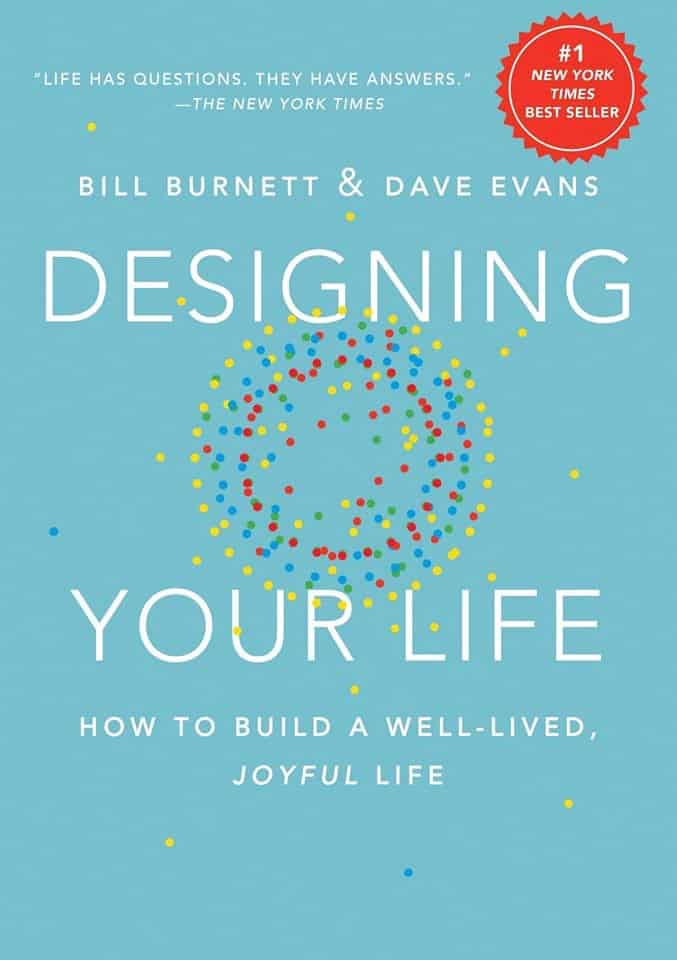
Just last week, I revisited a publication that illuminated how to translate this abstract concept into tangible steps. That publication is Designing Your Life by Bill Burnett and Dave Evans. On the surface, it appears to focus on discovering a fulfilling career. In truth, it equips you to survey the vast multiverse of possibilities and select the reality that best suits you.
At its foundation, Designing Your Life serves as a career guide primarily aimed at young adults. Its content draws directly from a popular Stanford University course co-taught by the authors.
Bill Burnett holds the position of executive director for the Stanford Design Program and contributed to Apple’s pioneering laptop development efforts. Dave Evans co-directs the Stanford Life Design Lab and was among the earliest hires at Electronic Arts, the renowned video game enterprise.
Burnett and Evans guide students—and by extension, readers—to harness design principles in charting their life’s trajectory. Although the methodology and jargon can occasionally feel contrived, it predominantly succeeds with striking effectiveness. The book abounds with enlightening epiphanies that shift perspectives.
What constitutes a well-crafted life? What does such a concept truly entail? “A well-designed life is one that flows logically,” assert the authors. “It’s a life where your identity, your convictions, and your actions harmonize seamlessly.” They term this harmony coherence, a notion I find exceptionally insightful.
To cultivate such coherence, the authors advocate embracing five essential mindsets:
Rooted in a genuine university curriculum, the book overflows with practical exercises. Originally assignments for Stanford enrollees, these serve as powerful tools for anyone seeking lucidity, regardless of age.
Consider one such activity: crafting a 250-word Workview—a concise manifesto on work’s purpose and markers of fulfilling employment—paired with a 250-word Lifeview outlining what renders existence meaningful. Then, dissect their intersections and tensions.
Yet, the exercise that captivates me most evokes multiverse imagery.
“The existence you’re navigating is merely one among countless you’ll inhabit,” declare Burnett and Evans. “Truthfully, a single lifetime encompasses multiple distinct lives. If your present path feels misaligned, fear not; life design offers infinite do-overs.”
To illustrate, they prompt envisioning three divergent futures via three five-year Odyssey Plans.
An Odyssey Plan functions as a blueprint to an alternative reality—a detailed projection of your life in five years. By generating three variants, you confront the abundance of viable paths ahead.
This framework exhilarates me, filling a gap in my own methodologies.
In speaking engagements, I typically delve into money and purpose, guiding participants toward life’s meaning via targeted activities. Ultimately, I aid in formulating personal mission statements. However, I’ve sensed an incompleteness. Odyssey Plans provide the bridge, operationalizing abstract missions into concrete strategies.
To demonstrate, here’s a personalized illustration of their intent (a close adaptation). Examine three prospective futures for myself.
The first Odyssey Plan extrapolates from your status quo. For me, this centers on Get Rich Slowly, my favored trajectory. I possess a vivid blueprint for the site’s evolution, and despite recent setbacks, steady advancement persists.
In this envisioned scenario, five years hence, the platform boasts a sleek, reader-centric aesthetic—ad-free, tracker-free, social-media-free, devoid of fluff. The blog endures, augmented by modular “online textbooks” dissecting personal finance niches.
Concurrently, I’d expand the GRS YouTube channel with video adaptations of cornerstone pieces. Ideally, this sustains me financially (admittedly challenging sans advertising). Essentially, amplify my current endeavors with greater fervor and focus.
The second plan contemplates life post-current vocation’s demise. Often, it parallels the familiar; for me, it partially does—I’d continue writing, but pivot from finance.
My cousin Duane’s final two months ignited a passion for hospice contributions via writing. How might a wordsmith aid the terminally ill? The response seems evident upon reflection.
This alternate path involves facilitating life story capture. It thrills me, merging my skills seamlessly. I’d interview individuals, master memory-provoking queries, transcribe narratives into cherished family artifacts. A regret unfulfilled with my father, partially realized with Duane, and actively pursued with Kim’s kin—whose tales rival epic sagas.
Thus, my secondary vision: empowering legacy through storytelling.
The third plan indulges fantasies, unhindered by economics or critique.
For over a year, a bold notion has simmered: enrolling in art school to launch a personal finance webcomic. Lifelong comics aficionado meets 15-year money scribe—a perfect synthesis. The premise: Penny Short, relocating to an animal-populated hamlet where beasts parody finance luminaries.
Enter Pete the Canadian Beaver, epitome of thrift, cycling defiantly against excess. Sam the Samurai Duck cleaves fiscal enigmas. Marla the Bear, Tom the Turtle, and Frugalwoods residents abound.
That’s my dream itinerary: art education followed by comic creation.
I trust this vignette underscores the exercise’s potency. Charting three futures expands horizons profoundly—one of myriad tools in the book.
Designing Your Life excels; I endorse it wholeheartedly. It joins an elite cadre of recommended reads for those adrift, alongside Your Money or Your Life, I Will Teach You to Be Rich, and The Simple Path to Wealth.
Its excellence compels me to tackle every exercise, joined by Kim and Craig.
Even sans exercises, the wisdom gleaned—actionable insights and probing queries—proves invaluable.
Paramount for me: the multiverse transcends fiction, applicable now. Aligning values with reality via diverse five-year blueprints enables anyone to construct a vibrant, purposeful existence.
One minor gripe: the absence of an index baffles me. For a design-centric tome dense with quotable gems, navigating sans quick reference frustrates—flipping pages repeatedly undermines its ethos.