Not Sure Where To Start?
One question. Seven possible paths. Find the right articles for your financial situation in seconds.


Over recent years, I’ve significantly altered my shopping habits. Although the change has been gradual, it has resulted in far greater contentment with my purchases.
Previously, my shopping method was straightforward. When I desired a new item—let’s call it a versatile essential—I would head to a physical store or, more recently, browse an online retailer and select from whatever options were presented. I’d evaluate the assortment on offer and choose the one that seemed most appropriate for my needs.
For particularly costly or crucial items, I might broaden my hunt across several stores or websites. However, in most cases, I settled for the initial venue I encountered.
The crucial aspect of this mindset was permitting the shopping locations to dictate the boundaries of my choices. I refer to this as ‘store-focused shopping.’ The inventory of the store essentially shaped the entirety of my available selections.
As I’ve matured, I’ve reversed this dynamic entirely. Rather than letting the market determine what products are accessible to me, I first pinpoint precisely what I require before launching any search. I prioritize my own preferences and necessities. Once I’ve clarified my desires, I invest the effort needed to source them. In nearly every instance, the ideal item exists somewhere—if I’m willing to persevere in tracking it down.
I term this strategy ‘self-focused shopping.’ By placing myself at the center, I’m fostering a truly positive outcome. In reality, it’s an outstanding practice! This technique reliably yields higher satisfaction with acquisitions. Rather than settling for inexpensive, generic products, I acquire items that seem tailor-made for my lifestyle.
To illustrate, consider a real-world case.
Approximately every five years, my wallet reaches the end of its usable life—it either deteriorates or goes missing—and I need a replacement.
Traditionally, the process was uncomplicated. Once the wallet showed signs of failure or vanished, I’d visit a local department store to peruse their offerings. I’d scan the displayed options, select the most appealing one, purchase it, and rely on it for the subsequent five years.
This routine has defined my wallet purchases from the very first one, spanning over three decades.
In 2019, as my wallet began to fray once more, I thought, ‘Time for a new one,’ but the prospect filled me with dread. As per usual, I’d trudge to the store and sift through an array of similar, uninspiring choices. The reality is, most standard wallets don’t suit me. They may serve others well, but they fall short for my purposes.
I’m not someone who carries a bulky load like certain sitcom characters. I don’t haul around thick wads of cash. All I require is a compact holder that slips easily into my pocket and provides quick access to a handful of cards. Bulkiness is a no-go, and leather isn’t essential. I sought a wallet aligned with my specific daily rhythms.
During this period, I passed by a store from a Dutch brand specializing in sleek, metal-constructed minimalist wallets. Curious, I entered to explore their range. I almost purchased one of their card holders that day, but concluded it was excessively sparse—it accommodated just six cards and little else. Departing the store, however, crystallized my decision to adopt a fresh strategy for this purchase.
I compiled a detailed list of wallet must-haves:
Armed with these criteria, I systematically searched platforms like Amazon, outdoor retailers like REI, and various other physical and digital outlets. I encountered numerous minimalist designs, including imitators of the Dutch brand, yet none fully matched my specifications.
Then, a memory sparked: a company renowned for innovative travel accessories. Their compact 19-liter backpack serves as my everyday carry and has proven reliable for multi-week trips abroad. This brand excels at integrating abundant functionality into minimal footprints. Could they offer a travel-oriented wallet? Indeed, they did.
Their minimalist wallet precisely hit the mark: three compartments, matching the dimensions of the benchmark but at half the weight. If tasked with designing my ideal wallet, this would be the blueprint. I ordered it immediately. I’ve relied on it daily ever since, and it’s exceeded expectations. My partner admires it too—she procured one for herself and frequently opts for it over a traditional handbag.
The wallet anecdote exemplifies self-focused shopping in action. In the past, I deferred to retailers to curate my options, which often meant compromising on the true ideal and grabbing the nearest approximation.
These days, I’m far more selective. I’ve cultivated the discipline to meticulously outline my exact requirements for any item prior to purchase. I even jot them down on a physical note card to ensure nothing slips my mind amid the shopping process.
Admittedly, this self-focused method can incur higher costs, but I’ve grown accepting of that trade-off. With age comes diminishing tolerance for subpar merchandise. For daily-use items especially, I demand durability, precise functionality, and, ideally, an element of delight. Echoing popular decluttering wisdom, I seek products that genuinely enhance my life.
For some, this philosophy might seem patently obvious: ‘Naturally, that’s the optimal way to shop—why settle for less?’ Yet, for me, it represents a profound evolution.
In my youth, options were scarce. Raised in a modest rural Oregon community with financial constraints, my choices boiled down to the sparse stock at the local variety shop or drugstore. Full stop.
Now, with greater maturity comes increased patience, financial stability, and, above all, the boundless reach of the internet. No longer confined to local shelves, I can theoretically source any global product—provided I invest in the hunt. Thus, I commence by defining my precise vision upfront.
This shift has profoundly curbed spontaneous buys. It turns out impulsive purchases thrive in the fog of undefined desires.
An unexpected benefit of self-focused shopping is heightened allegiance to standout products and brands. Once I discover a gem, I repurchase it repeatedly. For my wallet replacement, that means sticking with the identical model from the travel gear specialist.
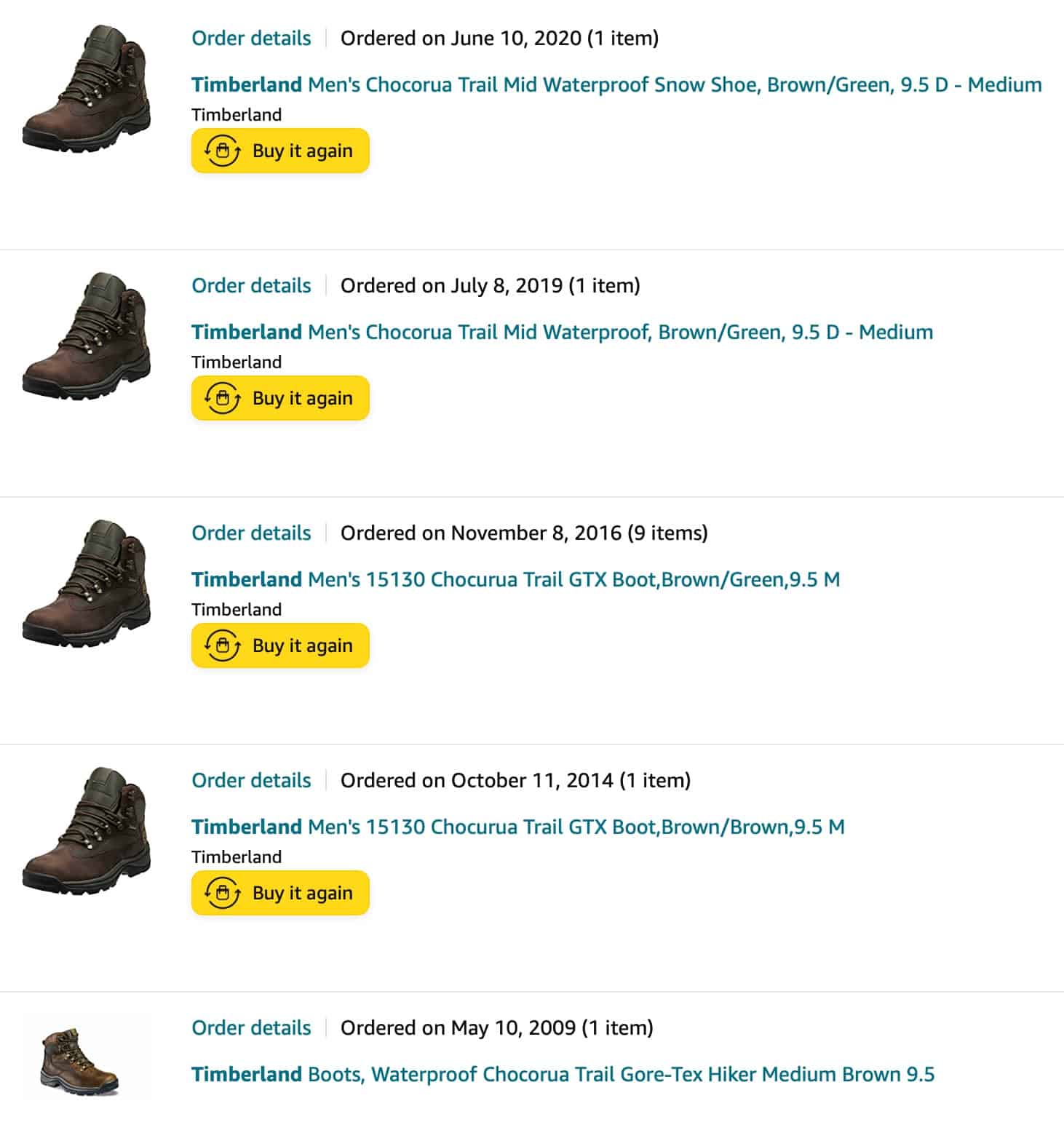
Consider my hiking footwear. Every five to seven years, I refresh my supply of a specific rugged boot model. My order records might suggest more frequent buys, but that’s due to maintaining dual pairs: one for heavy use and one for lighter occasions. Each endures half a decade or more.
I’ve depended on these boots near-daily for a decade and a half, despite occasional partner exasperation. Their potential discontinuation would be a genuine loss.
Formerly, my routine was: Identify the need, visit a retailer or site, snag the top available fit.
The updated self-focused protocol unfolds as:
Surveying my workspace this morning reveals that the majority of my everyday implements were sourced via this deliberate method. These are items I repurchase—or intend to—because they align perfectly. Examples include:
Even my desk itself emerged from this approach. After over a decade with a budget particleboard unit that bred chaos and inefficiency, our recent relocation prompted a rethink. I envisioned my ultimate workstation, then scoured options for weeks. Ultimately, a superb L-shaped wooden piece from a nearby outfitter became my setup.
A handful of desk accessories still hail from the old haphazard era: my audio input, secondary display (terribly underwhelming), and sharpener. They suffice adequately, so no urgency drives upgrades. When the time comes, though, self-focused shopping will guide the choices.
Another advantage of this method shines through in decision-making dynamics. Traditional shopping bombards with dozens of similar wallets, triggering choice overload and hesitation.
Self-focused shopping narrows the field dramatically—often to a single viable contender after diligent pursuit. This eliminates overwhelm, sidesteps post-purchase doubt, and streamlines satisfaction.