Not Sure Where To Start?
One question. Seven possible paths. Find the right articles for your financial situation in seconds.


Ever since launching Financial Samurai back in 2009, I have been aiming to shed about 10 pounds, which equates to roughly 6% of my total body weight. Over the years, I managed to drop between five and six pounds in certain periods, yet I never quite achieved that ambitious double-digit target. Consequently, for over 16 years, I struggled to accomplish what seemed like a simple goal, particularly for someone who prides himself on being a logical economist and personal finance enthusiast.
There were times when I toyed with the notion of purposely packing on a significant amount of weight, simply to make the subsequent loss of 10 pounds feel more attainable. This concept mirrored the strategy of accumulating massive credit card debt to fully indulge in life’s pleasures, followed by a triumphant celebration upon clearing it all. I observed individuals online employing this approach and receiving accolades as if they were conquering heroes.
Rather than intentionally gaining weight, I ultimately concluded that it would be far wiser to focus directly on shedding the excess. Remarkably, the key turned out to be the application of two fundamental economic concepts: reduction and substitution. Once I put these into practice, the pounds melted away over a span of just six months.
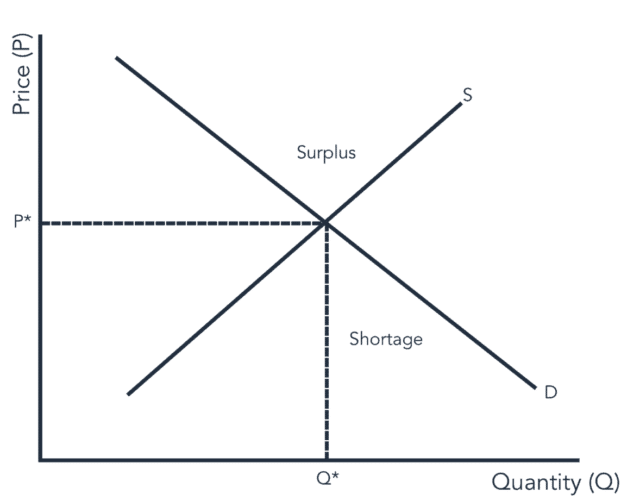
In economics, when the price of a product increases, the amount people consume typically decreases. This dynamic is vividly depicted in the traditional supply-and-demand graph.
Consider a scenario where every meal costs $25, and my food budget is limited to $100. That allows for exactly four meals. Now, if the price jumps to $33.34 per meal, the same $100 budget stretches to only three meals. With a constrained budget in place, a sensible consumer naturally cuts back consumption by approximately 25 to 30 percent.
Financial pitfalls often arise when we disregard this core principle. Rather than adapting our habits, we might shell out $134 for those four meals, swallow the elevated expense, and then lament the rise in food prices.
A far more effective strategy involves leveraging those elevated prices as a prompt to eat less. Cutting back on dining out not only keeps spending in check but frequently enhances overall health too. The result is a dual benefit: reduced expenditures paired with stronger self-discipline.
Certainly, tackling inflation is conceptually simple yet challenging in execution. As investors, we have enjoyed solid returns lately, which has made it tempting to splurge on meals. Nevertheless, as a pragmatic economist, altering your habits is essential if you aim to alter your results.
As food prices escalate, the logical response is for consumption to decline accordingly.
Drawing from the straightforward economic rule that rising prices ought to curb consumption, I should have shed considerable weight throughout the pandemic.
In reality, beginning in 2020, our household food expenditures surged as we turned increasingly to delivery services. This shift felt justified at the outset. Delivery offered convenience, saved precious time, and minimized exposure to health risks, particularly with our newborn daughter arriving in December 2019, whose immune system was still developing.
The issue emerged because delivery meals generally carry a 20% premium over pickup options and about 50% more than preparing food at home. Juggling a newborn alongside a three-and-a-half-year-old, we rationalized the extra cost as an indispensable time-saving measure.
Remarkably, five years on, we continued relying on delivery with regularity. Beyond the steep costs, restaurant-prepared dishes tend to be less nutritious, loaded with extra sugars and salts to enhance flavor and shelf life.
Successfully losing weight often requires a compelling trigger. For me, it materialized during a five-week stay with my parents in July 2025. My father, standing around six feet tall and weighing approximately 155 pounds, pointed out that I appeared chubby. Ouch, thanks Dad. I countered by suggesting he could benefit from adding some weight and muscle himself.
Beneath the banter, I recognized the truth in his observation. Measuring five foot ten and tipping the scales at 172 pounds, I had some excess to trim. Nothing underscores carrying extra weight quite like a trip to Hawaii, where beach time demands shedding the shirt. Once the drive to attract a partner fades—since you already have one—it’s easy to let physical maintenance slip.
Staying with my parents eliminated at least $20,000 in potential lodging expenses. At first, my concerns narrowed to just food and transport. That shifted when I embarked on remodeling my parents-in-law’s unit, a project I initially budgeted at $25,000 but which ballooned to $41,000. It marked the largest outlay in a four-week stretch since my previous home renovation from 2019 to 2022.
Watching those invoices accumulate sharpened my vigilance over every expenditure. When costs escalate, the cash flow for all other areas contracts sharply. Among the remaining adjustable categories, food stood out as highly flexible.
Thus, I consciously chose to curtail food spending to bolster cash flow. For instance, rather than dropping $25 on an additional poke container from Fresh Catch, we made do with smaller portions. Ironically, my parents covered 85% of the remodel costs in the end, though I hadn’t anticipated that, prompting my proactive cutbacks.
Upon returning from Hawaii, I took a hard look at our food budget and was shocked by the findings. Our family of four was averaging around $3,500 monthly on groceries and meals.
While I oversee our investment portfolio and generate supplementary retirement income via this platform and my books, I typically leave day-to-day household budgeting to others.
In my estimation, we were hovering around $2,500 per month for food. Post-2021 inflation waves reshaped that landscape entirely. Despite some easing in overall inflation rates, our food expenses remain about 40 percent steeper than five years prior.
I had been mentally anchored to outdated pricing until facing the raw data. Inflation excels at creeping up unnoticed, distorting our perceptions over time.
Clinging to obsolete price recollections underscores why everyone ought to perform a comprehensive financial audit annually. Our recollections frequently diverge from current conditions.
This represents the classic anchoring error that older generations commit when reminiscing about bargain prices in their youth, claiming mere hard work sufficed. They overlook inflation’s compounding erosion against wage growth.
Armed with our actual spending figures, my wife and I devised a structured monthly food strategy. The objective: revert to $2,500 monthly, pocketing $1,000 savings, all while prioritizing healthier choices. This entailed not just eating less but smart substitutions.
The primary switch: transitioning from frequent delivery orders to preparing more meals in our own kitchen.
Residing in San Francisco—one of America’s premier culinary hubs—complicates this shift. We pioneer the very technologies enabling seamless food delivery. Moreover, we are enveloped by countless top-tier restaurants spanning global cuisines, all accessible via quick delivery.
Lately, I stumbled upon Khao Tiew, home to the finest khao soi I have tasted. Regrettably, with boneless beef short rib and taxes, pickup tallies about $28. Temporarily, I have swapped it for $1.49 instant ramen, embracing it as a discipline exercise. Substitution in action!

Khao Tiew, nestled on San Francisco’s west side, delivers exceptionally flavorful Thai cuisine.
Once you have scrutinized your budget, determined reduction targets, and identified substitutions, commit your weight loss motivations to writing. A compelling ‘why’ empowers nearly any endeavor.
Here are mine:
By mid-October, after three months of effort, my weight had decreased from 173 pounds to 168 pounds. The progress felt substantial, beyond mere water loss—it was genuine fat reduction.
Then, a Business Insider crew visited for an interview on frugal family living. Viewing myself on video reignited my drive. Indeed, the camera adds those notorious 10 pounds.
Post-release, I gained newfound sympathy for performers and stars fixated on fitness regimens, weight-loss medications, enhancements, and rigorous diets. When appearance influences career prospects and opportunities, the imperative to optimize looks becomes profoundly compelling.
This encounter further solidified my preference to avoid video content, steering clear of superficial validation traps. I remain committed to writing and podcasting, where substance trumps visuals. For a potent weight loss motivator, though, record and review yourself.
Should food prices drop, consumption would predictably surge. Tempting cuisine proves hard to bypass. Yet, witnessing my preferred supermarket steak climb from $28 per pound to $32, then $39, prompted me to halt purchases. Initially, I pivoted to $12 cheeseburgers. Gradually, I scaled back meat intake overall.
As delivery surcharges and menu rates rose, forgoing them entirely grew feasible. Family meals for four that previously totaled under $85 now surpass $140 routinely. Suddenly, $15 rice porridge with chicken and cabbage, stretching two days, appealed immensely.
Accustomed to a slimmer midsection now, reversion holds no allure. Court endurance has enhanced, and I sense greater vitality. As Steven Tyler quipped, nothing surpasses the sensation of being lean.
Though steeper food bills sting, I find myself thankful. For years, I coasted without dissecting food costs, indulging freely. America’s plenty fosters such complacency.
Through reduced intake, I not only slimmed down but fortified financial habits. Perhaps one day I will hit 155 pounds, my high school weight, and mirror my dad’s longevity to 80.
Who am I fooling? 155 feels excessively light. I am content at around 165 pounds, give or take two, indefinitely. Keep pushing forward!
Readers, have you scaled back consumption or swapped out pricier foods amid recent surges? In what ways have your routines evolved since the pandemic? Do you embody the rational economist and finance expert, adapting seamlessly to price shifts?