Not Sure Where To Start?
One question. Seven possible paths. Find the right articles for your financial situation in seconds.


At 53 years old, I had never permitted myself to purchase a vehicle that I genuinely adored… until this moment. This narrative details how I finally embraced making a substantial investment purely for personal delight. Surprisingly, it was not a transaction I had planned beforehand. Allow me to elaborate on the circumstances that led to this decision.
In the height of the COVID-19 crisis, specifically during early July 2020, I invested $35,990 in a pre-owned 2019 Mini Countryman SE All4. I affectionately refer to the Countryman as a ‘Maxi Cooper.’ While it is far from a poor vehicle, I experienced immediate remorse after the purchase. My original intention was to upgrade from my 2004 Mini Cooper to a more recent iteration of the identical model. However, I permitted myself to be persuaded into acquiring a compact sport utility vehicle instead.
For a full two years, I operated the Maxi Cooper and simply endured it. Objectively, it was not a substandard automobile in any regard, but it proved to be an unsuitable match for my preferences. Personally, I am not inclined toward SUVs. My affinity lies with compact automobiles.
Just last month, I brought the Maxi Cooper to the dealership for a routine oil change. During my wait, the service team unexpectedly proposed purchasing the vehicle directly from me. This offer caught me completely off guard.
As many are aware, the market for used vehicles across the United States has been extraordinarily volatile over the past few years. Data from the U.S. Federal Reserve indicates that prices for used vehicles have surged by 55 percent since July 2020. In contrast, prices for brand-new vehicles have risen during the same period, albeit by a more modest 18 percent.
Given my professional focus on personal finance topics, I was well-informed about the elevated prices in the used-car sector. Yet, I had not contemplated the possibility of selling the car I acquired merely two years prior. Typically, I am the type of individual who purchases a vehicle and retains it for ten years or longer. Nevertheless, when the Mini dealership informed me they were willing to pay $33,000 for the car I bought 26 months earlier, my interest was piqued significantly.
I reached out to a close friend who previously worked as a car salesperson. ‘What potential pitfalls am I overlooking here, Jeremy?’ I inquired. ‘This appears to be an exceptionally favorable arrangement.’
‘It’s beyond favorable,’ Jeremy replied emphatically. ‘It’s nothing short of miraculous. Effectively, it’s as though you leased the vehicle for just $115 monthly. Accept the offer immediately, before they reconsider.’
Following the Mini dealer’s buyback proposal, I dove deeply into extensive research on automobiles. In doing so, I made a solemn commitment to myself: For the first time—and possibly the only time—in my life, I would select a model that perfectly aligned with my desires, free from any concessions.
Throughout my history of vehicle ownership, each purchase has entailed some form of compromise. In my younger days, the primary limitation was financial; I could not afford premium options, restricting my choices accordingly. More recently, I have settled for pre-owned models. Then, I opted for a compact SUV over a sports car, among other trade-offs.
On this occasion, however, I refused to settle. My goal was to acquire precisely the vehicle that captivated me. The challenge remained: Which one would that be?
Since I had no prior plans to part with my Maxi Cooper, I had devoted zero thought to potential replacements. Conventionally, individuals determine their desired model before divesting their current one. I was proceeding in reverse order. I was adapting my self-centered shopping methodology to the realm of automobile acquisition.
Temporarily, I contemplated forgoing a replacement altogether. I still possess a 1993 Toyota pickup truck. Though aesthetically unappealing, it remains fully functional. Moreover, Corvallis is a compact city boasting superior infrastructure for non-motorized transport. I routinely walk over 20 miles weekly within the community and would welcome even more pedestrian activity. This past summer, I have incorporated longer bike rides for errands. Embracing a car-free lifestyle was a viable consideration, as was procuring another 2004 Mini Cooper. In the end, however, I resolved to leverage this serendipitous moment to transition to a new automobile of some variety.
Before proceeding further, it is essential to clarify several aspects of my longstanding relationship with cars.
My quintessential ideal persists as the 2004 Mini Cooper, enhanced hypothetically with contemporary technological advancements suitable for 2022 standards. Regrettably, such a vehicle does not exist. Current Mini models have grown larger over the past two decades. Compounding this, their owner satisfaction ratings have declined noticeably. (I also admire the Audi A1, though it remains unavailable in the American market.)
I dedicated an intensive 24-hour period to scrutinizing potential options. As I absorbed information on various models, I compiled a detailed list of mandatory criteria for my successor vehicle. These requirements, most of which align with my earlier remarks, included the following.
Early in my investigation, I encountered the Consumer Reports car finder tool, accessible exclusively to subscribers. This straightforward three-question assessment proved invaluable.
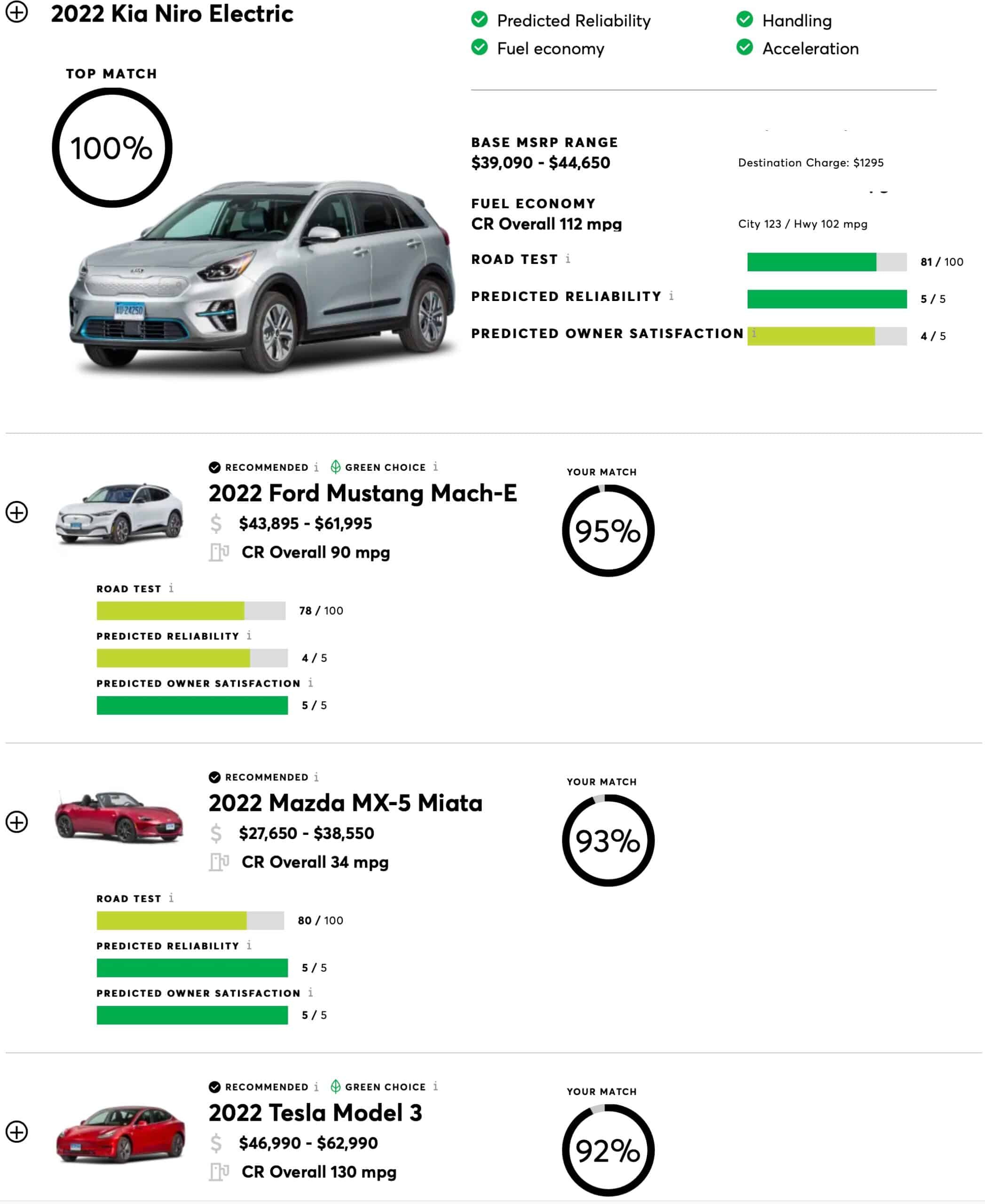
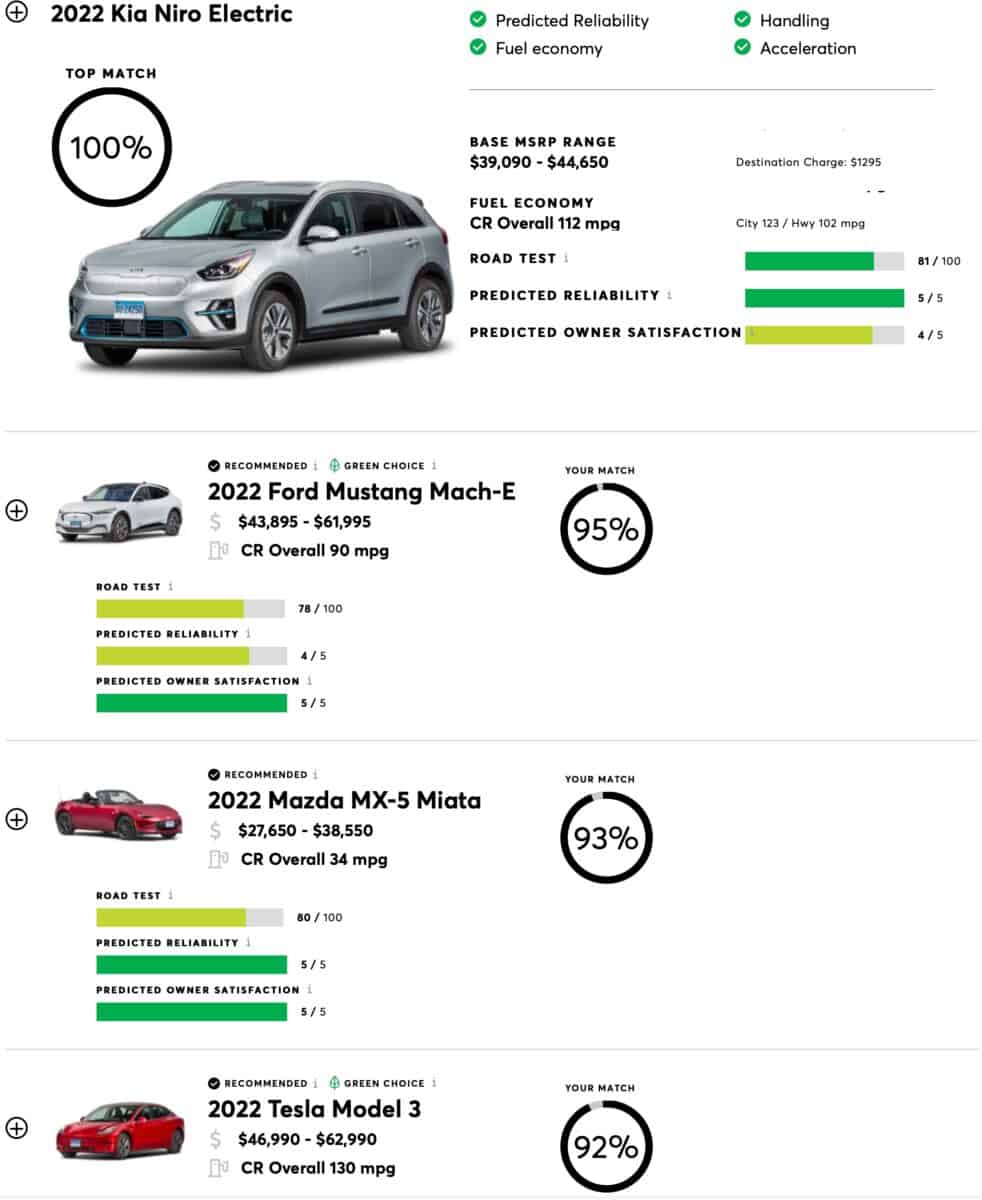
The tool identified five vehicles ideally matching my profile: the Kia Niro Electric, Ford Mustang Mach-E, Mazda Miata, Tesla Model 3, and Hyundai Ioniq 5.
Despite temptation, I dismissed the Tesla due to its prohibitive cost and subpar reliability metrics. The Kia and Hyundai were excluded for failing to achieve peak owner satisfaction levels. The electric Mustang, while intriguing, is not a sedan but an SUV, mirroring the characteristics of my Maxi Cooper—a category I explicitly avoided. (It remains unclear why Consumer Reports suggested SUVs despite my deliberate exclusions.) This narrowed the field to a single standout: the Mazda Miata.
Truthfully, Miatas have long held a magnetic appeal for me. Their visual design captivates, they garner consistent acclaim from both consumers and experts, and they fulfill every criterion that draws me to the Mini Cooper.
The Miata rapidly ascended to the pinnacle of my abbreviated shortlist. Accompanying it were the enduringly beloved Mini Cooper, despite its imperfections, and the pragmatically versatile Subaru Outback, emblematic of Oregon’s unofficial vehicular staple.
Comparative analyses from Consumer Reports and Kelley Blue Book further illuminated the Miata’s superiority.
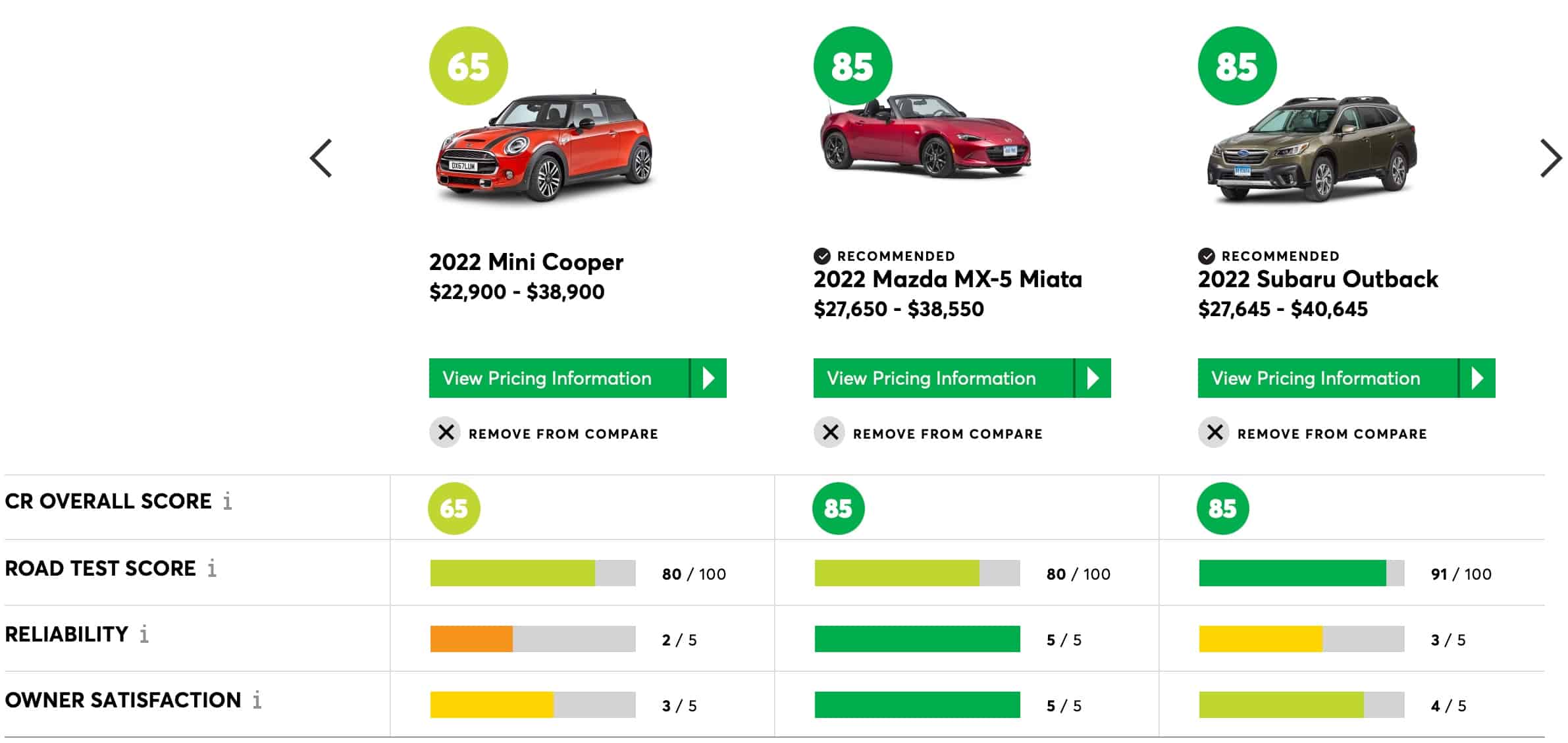
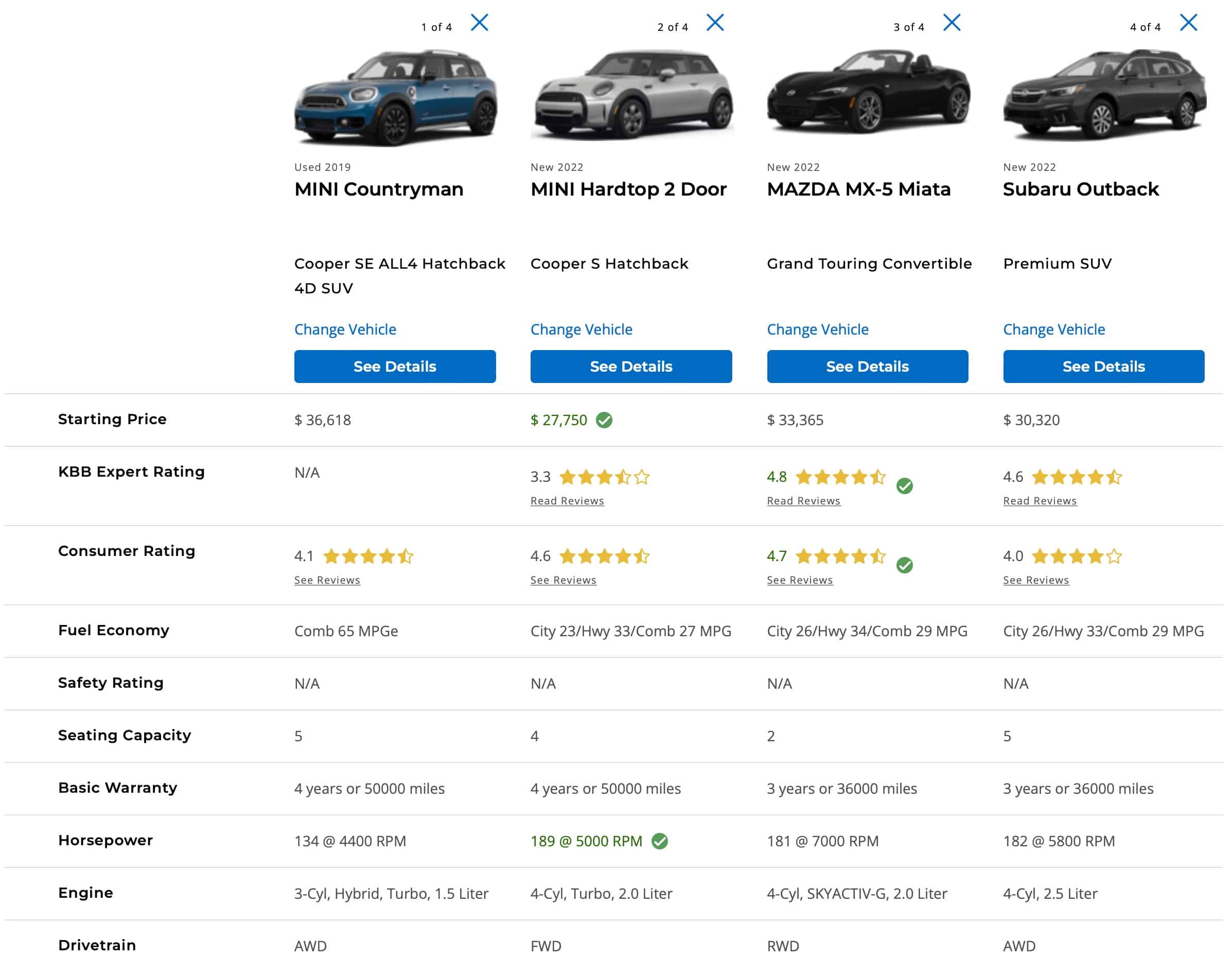
These metrics underscore why the Miata emerged as my unequivocal frontrunner. Its sole notable drawback—a moderate road-test score—did not deter me upon closer examination. The cited issues, such as road noise and limited interior space, held no significance for my needs.
Consumer Reports extolled: ‘The MX-5’s sparkling combination of nimble fun and thriftiness has made it a favorite at our test track—and the current model holds to the standard. The Miata is a completely impractical car. It seats two (tightly), it will barely haul a load of groceries, and it’s loud inside. Yet we’re smitten with this plucky ragtop. There isn’t a better fun-per-dollar performance car on the market that delivers the Miata’s magic. After a long winter’s nap, the MX-5 will revive your senses the first spring day you drop the top and hit the curvy roads. This Mazda is one of the last intimate driving experiences; you feel like part of the machine that’s melding with the road. The Miata’s steering gives immediate turn-in response, and the car remains playful and predictable even when pressing the limits of the tires.’
I ceased exploring alternatives and instead sought justifications to reject the Miata. None materialized. Consumer Reports, Edmunds, and Motor Trend all lavished praise upon it, as did countless YouTube evaluations. Ultimately, a review from an automotive care channel sealed my conviction: ‘It’ll bring joy to your heart every time you drive it.’
Acquiring a car constitutes a monumental commitment, and I am unaccustomed to hasty decisions of this magnitude. Ordinarily, I deliberate extensively, pondering every facet meticulously. This instance deviated sharply from my norm. On the final Thursday of August, I journeyed to Salem to inspect the closest Mazda dealership.
Having contacted the salesperson beforehand, a Miata awaited my test drive. Mere moments after departing the lot—after traversing just fifty feet—I recognized this was the vehicle for me, contingent upon securing $33,000 for my Maxi Cooper. For appearances, I navigated five miles through Salem’s streets, engaging in cordial dialogue with the salesperson. I clarified that purchasing a new car was unplanned, prompted solely by the irresistible Mini offer. Would he consider matching it? ‘Possibly,’ he responded.
Upon returning to the premises, I presented the salesperson with documentation for my Maxi Cooper, including the Mini dealer’s formal written bid from the previous day. He conferred with his manager. Ten minutes elapsed before he returned bearing positive tidings: ‘We’ll match their offer.’
‘Excellent,’ I replied, producing another document—a screenshot from the dealership’s site. ‘This is my preferred model: a gray hardtop. However, your listing indicates it’s in transit.’
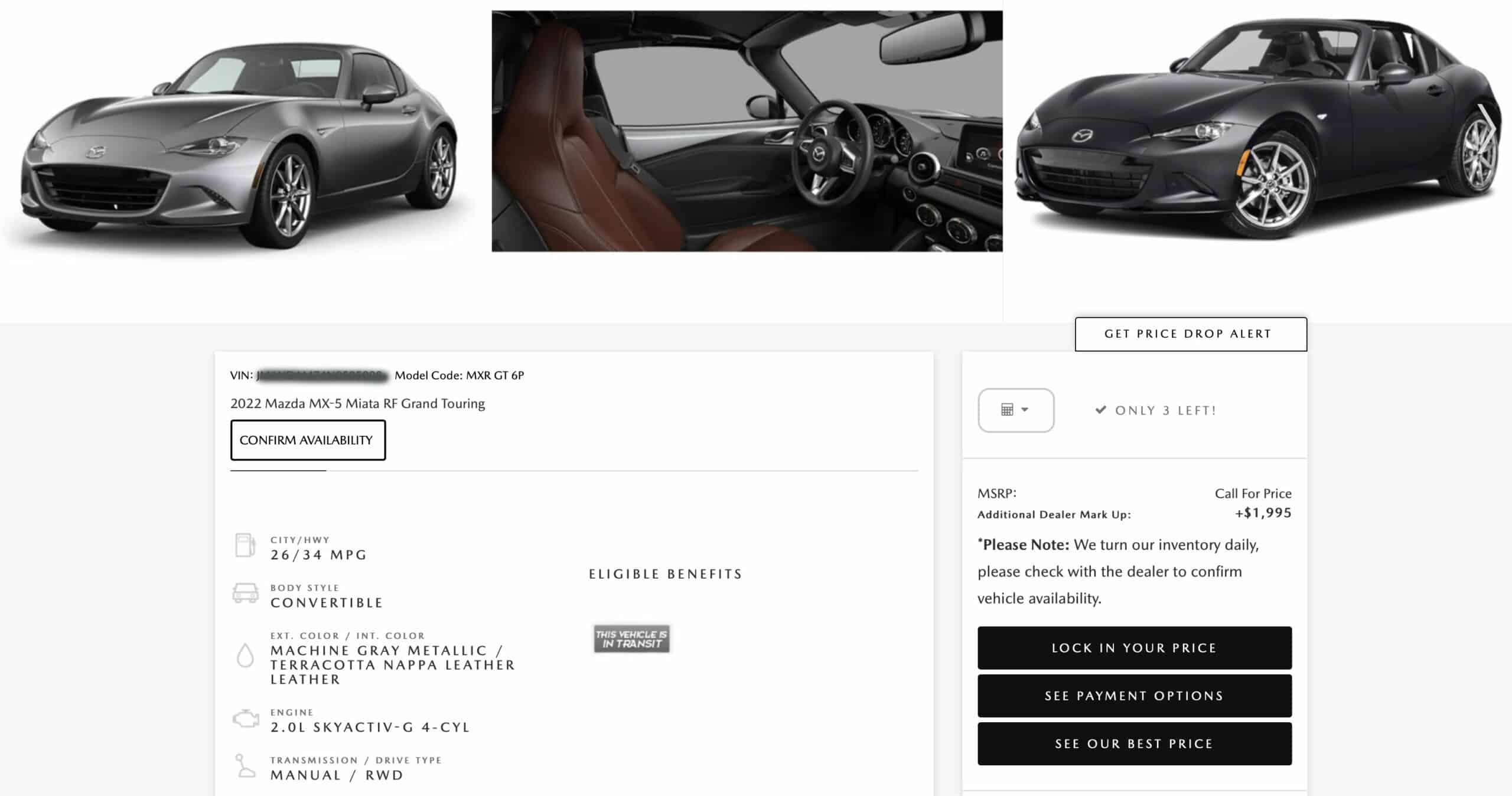
This marked the sole juncture where the salesperson hesitated. ‘What can I do to get you driving home in a car today?’ he urged, initiating the familiar four-square negotiation tactic.
‘I’m not departing with a vehicle today,’ I stated firmly. ‘You lack the exact model I desire.’ I gestured to the printout. Although five Miatas were inventory, none matched my specifications: gray exterior, manual transmission, hardtop. (All Miatas feature convertible tops.) The available units were red, automatic, or soft-top—or combinations thereof.
The salesperson acquiesced readily. ‘No issue at all,’ he assured. We briefly discussed pricing; the dealership held firm at $39,245 as listed online, incorporating a compulsory $1,995 market adjustment premium. I accepted this without contention. We exchanged handshakes, formalizing a provisional accord without executing documents. He promised to contact me upon the car’s arrival.
En route home, I reflected on the financial implications. To someone of my generation, $40,000 represents a substantial outlay for any automobile. Even $20,000 feels extravagant. I pondered whether a budget alternative like a Chevy Spark might suffice equally. Deep down, I knew it would not. As previously noted, lifelong compromises defined my automotive history. This time, I yearned to prioritize indulgence.
The core dilemma distilled to: Would I prefer (a) retaining the 2019 Maxi Cooper plus $7,000 in cash, or (b) owning a pristine 2022 Mazda Miata? Framing it thusly rendered the choice unambiguous—I would select the Miata without hesitation, time and again.
Was this irrational exuberance? Perhaps an excess of sentiment? (I acknowledge the decision’s emotional underpinning over pure logic. I accept this, provided it avoided recklessness.)
For validation, I consulted two trusted confidants. Initially, my friend Jeff encouraged unequivocally: ‘Do it!’ Subsequently, I broached the topic with my partner, Kim, anticipating resistance. To my relief, she endorsed it wholeheartedly: ‘You should absolutely proceed.’ Thus affirmed, I committed.
The Mazda representative phoned on August’s final day: ‘Your Miata arrived this morning. We can finalize today if desired.’ I halted my activities, drove to Salem, and consummated the purchase of a new car.
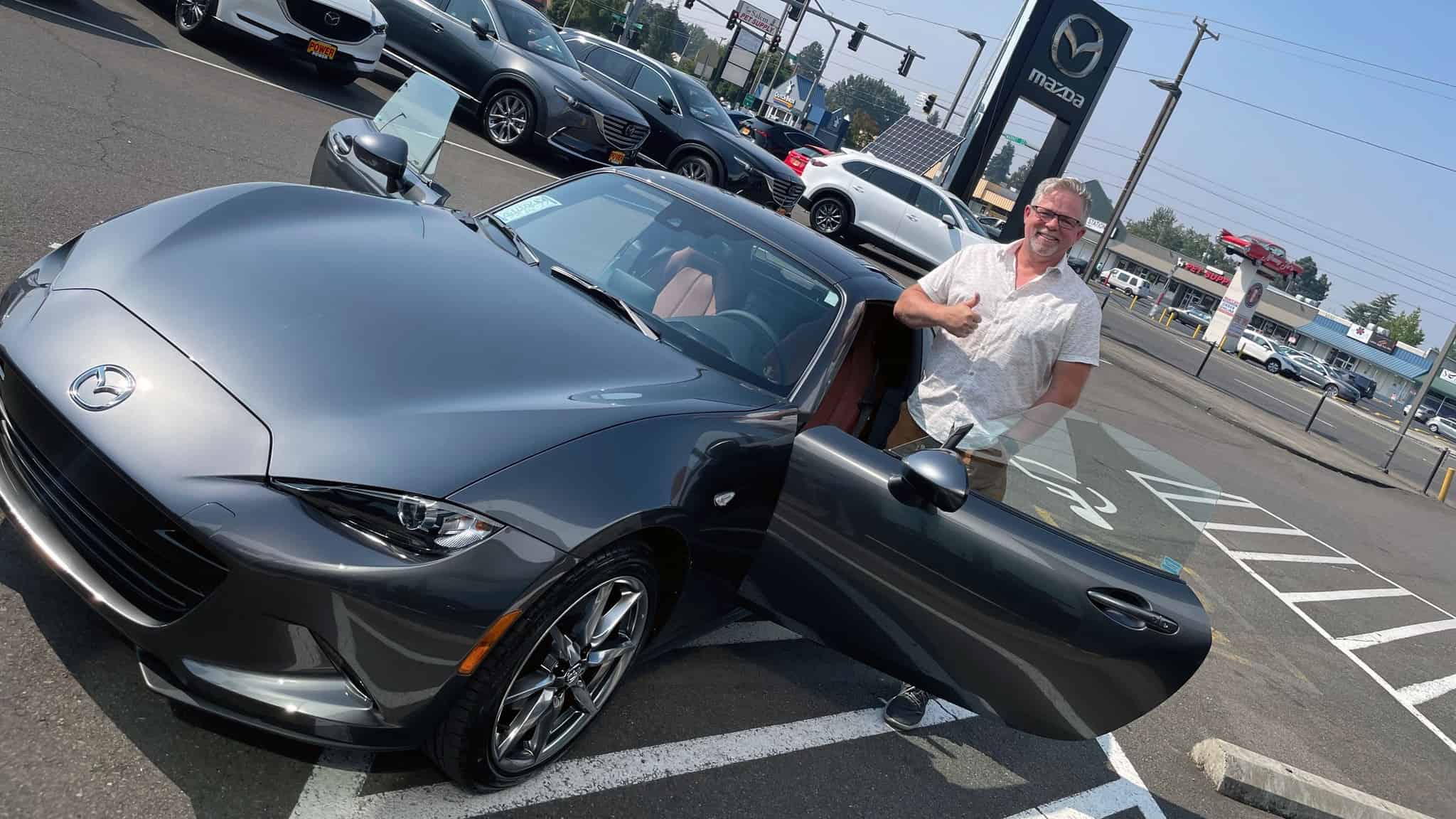
My Miata was extraordinarily fresh, registering only five miles on the odometer. As I completed financing paperwork, the representative remarked, ‘In thirty years, that’s the lowest mileage I’ve encountered.’
I opted for an extended scenic route homeward—from Salem to Corvallis via meandering riverside paths, undulating hills, and pastoral farmlands. With the convertible top retracted, sunlight caressed my skin as breezes tousled my hair. Taylor Swift’s ‘Welcome to New York’ resonated through the audio system. A profound smile radiated from within. The Miata truly infused joy into my spirit.
Earlier in June, I reflected on how my impoverished upbringing continues to engender guilt over acquiring luxuries. The Miata qualifies unequivocally as such a luxury. Remarkably, no remorse accompanies this acquisition.
Contemplating my choice evokes Ramit Sethi’s philosophy: Allocate resources to cultivate a fulfilling life. This automobile constitutes an integral element of my enriched existence.